Excluding Dental From Your HSA to Access the CDCP: What Health Canada Confirmed
Over the past year, a specific question kept coming up with prospects: can you exclude dental from your HSA so employees still qualify for the Canadian Dental Care Plan (CDCP)?
Our first instinct was no. Not because the technology couldn’t handle it, but because excluding dental from your HSA purely to preserve a public benefit felt like it ran against the whole point of offering a Health Spending Account in the first place.
So instead of guessing, we asked the regulator directly. Between February and August 2026, we went back and forth with Health Canada’s Oral Health Branch to get a written answer on whether excluding dental from your HSA actually changes CDCP eligibility. It does — and the rules around it are more specific than most advisors realize.
Why Employers Started Asking About Excluding Dental From Your HSA
A Health Spending Account is flexible by design. Employers set a tax-deductible budget, and employees decide how to spend it across CRA-eligible medical expenses — dental included, by default.
The CDCP changed the math. Once a federal dental program became available to Canadians without private coverage, some employers started asking whether excluding dental from an HSA would let lower-income employees access the CDCP on top of their existing health allowance — effectively getting two benefits instead of one.
It’s a reasonable question to ask. Whether it’s a reasonable thing to design around is a separate issue — and it’s the one we took to Health Canada.
The Paper Trail: Excluding Dental From Your HSA, Confirmed in Writing
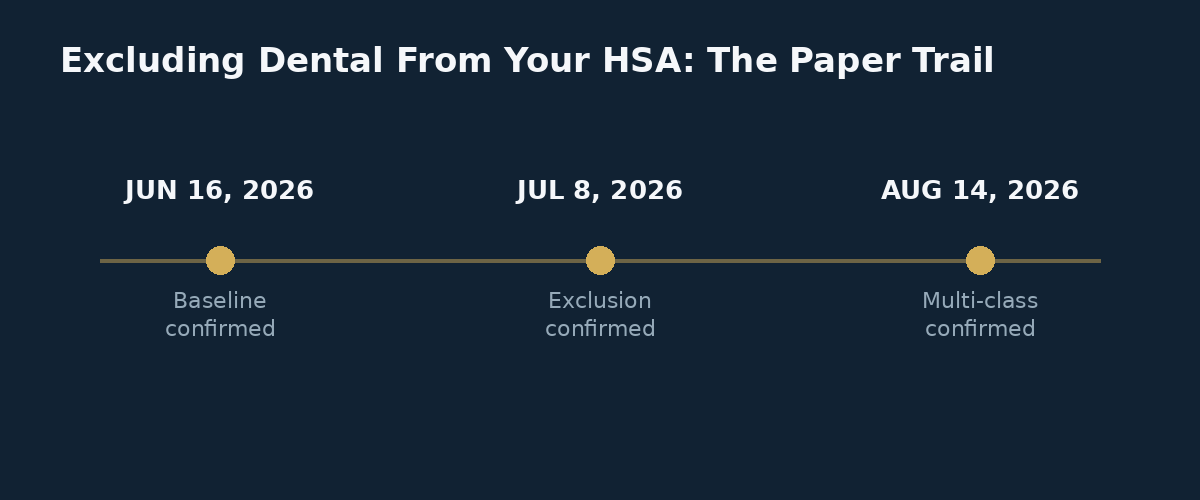
June 16, 2026 — The Baseline
Health Canada’s first response laid out the core intent of the program:
“The CDCP is intended to help those who currently have no access to dental coverage, not to replace current employer benefits packages they offer employees or pensioners as part of their competitive compensation packages.”
— Health Canada, Oral Health Branch
They also confirmed the access test is binary, not usage-based:
“Your understanding is correct that if dental care can be charged against an individual’s HSA, they are not eligible for the CDCP, even if they do not use the coverage provided by the HSA. As long as an individual has access to an HSA… that covers dental care, they are not eligible for the CDCP.”
— Health Canada, Oral Health Branch
In other words, simply having dental reimbursement available through an HSA disqualifies an employee from the CDCP — whether or not they ever submit a claim.
July 8, 2026 — The Direct Question on Excluding Dental From an HSA
We asked directly: if an employer instructs its HSA administrator to explicitly exclude dental, does the employee become eligible? Health Canada’s answer confirmed that excluding dental from an HSA does satisfy the non-access requirement:
“If a Health Spending Account offered by an employer or a pension plan administrator explicitly excludes dental expenses, an individual could be eligible for the CDCP as they would be considered not having access to dental insurance or coverage.”
— Health Canada, Oral Health Branch
Health Canada went further, recommending documentation to support the exclusion:
“To ensure potential CDCP members have documentation ready to confirm their non access to dental insurance through their Health Spending Account, we would recommend that the pension plan administrator prepares a letter confirming that their plan specifically excludes dental expenses.”
— Health Canada, Oral Health Branch
We also raised our concern about employers deliberately stripping dental coverage solely to shift employees onto the public plan. Health Canada’s response acknowledged the risk without closing the door on it:
“The parameters of the CDCP have been designed to help mitigate some of these risks, but we will continue to work with partners to assess potential impacts and explore available measures, as appropriate.”
— Health Canada, Oral Health Branch
August 14, 2026 — Multi-Class Plans
Finally, we asked how this applies when a company offers different HSA classes to different employee groups — for example, full-time staff with a dental-inclusive HSA and part-time staff with a dental-excluded HSA. Health Canada confirmed eligibility is assessed per employee, not per company:
“In the new scenarios that you’re mentioning, you are correct that Class A individuals would not meet the criteria and Class B individuals would meet the criteria.”
— Health Canada, Oral Health Branch
“The criteria about having access to dental insurance is applied at an individual level. It is common that level of access to insurance or coverage can vary within a company.”
— Health Canada, Oral Health Branch
Three Rules on Excluding Dental From Your HSA and CDCP Eligibility
Based on Health Canada’s written guidance, three rules govern how excluding dental from your HSA interacts with the CDCP:
- Access is evaluated individually. CDCP eligibility depends on whether that specific employee has dental coverage on December 31 of the tax year — not on the company’s plan as a whole.
- Explicit exclusion means no access. If dental expenses are specifically excluded from what an HSA will reimburse, the employee is treated as having no private dental coverage.
- Class-based structuring is compliant. Employers can offer one HSA class with dental and another without. Employees in the dental-excluded class can be reported with T4 Box 45 Code 1 — “not offered access to any kind of dental insurance or coverage.”
Class A vs. Class B: How Excluding Dental From an HSA Plays Out
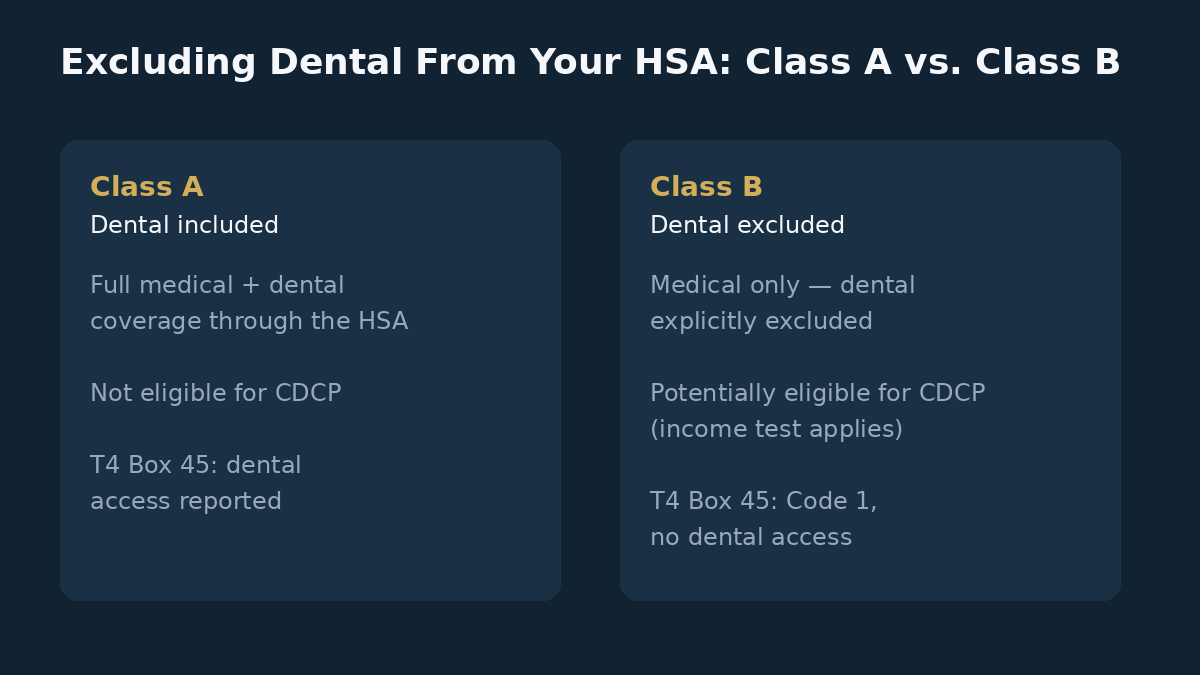
| Class A — Dental Included | Class B — Dental Excluded | |
|---|---|---|
| HSA coverage | Medical + dental | Medical only |
| CDCP eligibility | Not eligible | Potentially eligible (subject to income test) |
| T4 Box 45 code | Indicates dental access | Code 1 — no dental access |
| Best fit for | Employees who want dental reimbursed privately | Employees who’d rather rely on the CDCP for dental |
The Policy Trade-Off Behind Excluding Dental From an HSA
Here’s the structural problem. The CDCP eligibility test is binary — does the employee have dental coverage, yes or no — and binary rules create incentives.
Under this framework, an employer can offer a $2,000 annual HSA for vision, prescriptions, and therapy while excluding dental from the HSA entirely. That employee receives the full $2,000 in private benefits and qualifies for taxpayer-funded dental coverage if they meet the CDCP’s income threshold. Meanwhile, an employee at another company with a modest $500 comprehensive HSA that includes dental is deemed ineligible for the CDCP altogether — despite having far less in total benefits.
That’s the tension: excluding dental from an HSA is fully compliant, but it also allows private benefit dollars to be redirected around a program designed for people who have no coverage at all.
How Kibono Handles Excluding Dental From an HSA
Once Health Canada formally confirmed that non-dental HSA classes preserve CDCP eligibility, we updated the Kibono platform so employers can configure employee classes and restrict dental claim tags where appropriate.
If you want to offer a dental-excluded HSA class to a specific group of employees — while keeping full, CRA-eligible coverage for everyone else — Kibono supports that structure with the claim visibility and PHSP compliance you need to report it correctly. You can read more about how pay-per-claim pricing compares to pooled group benefits plans if you’re weighing your overall plan structure.
The Bottom Line on Excluding Dental From Your HSA
The Canadian Dental Care Plan was built to help Canadians who have no dental coverage at all — not to top up employees who already have a workplace health allowance. But because eligibility is based on a simple yes-or-no access test, excluding dental from your HSA is a legitimate, Health Canada-confirmed way to restructure a plan — even though it blurs the line between a private benefit and a public one.
If you’re considering excluding dental from your HSA for part of your team, the compliant path is clear: structure it as a distinct employee class, document the exclusion, and report it correctly on the T4.
Want Help Structuring an HSA With a Dental-Excluded Class?
Kibono’s pay-per-claim platform supports dental-inclusive and dental-excluded HSA classes side by side, with the documentation and claim tagging built in.
Book a consultation to talk through your options, or read more about employee benefits in Canada.
Frequently Asked Questions
Can you exclude dental from an HSA so employees qualify for the CDCP?
Yes. Health Canada has confirmed in writing that if a Health Spending Account explicitly excludes dental expenses, the employee is treated as having no access to dental coverage and may be eligible for the CDCP, subject to the program’s income test.
Does excluding dental from your HSA affect other employees on the plan?
No. CDCP eligibility is assessed at the individual level. An employer can offer one HSA class that includes dental and a separate class that excludes it, and each employee’s eligibility is determined by their own coverage.
What do employers need to do if they exclude dental from an HSA?
Document the exclusion clearly, confirm it in writing to employees who may apply for the CDCP, and report the correct code — Code 1, no dental access — in Box 45 of the affected employees’ T4 slips.